When the customer creating the database is an agent
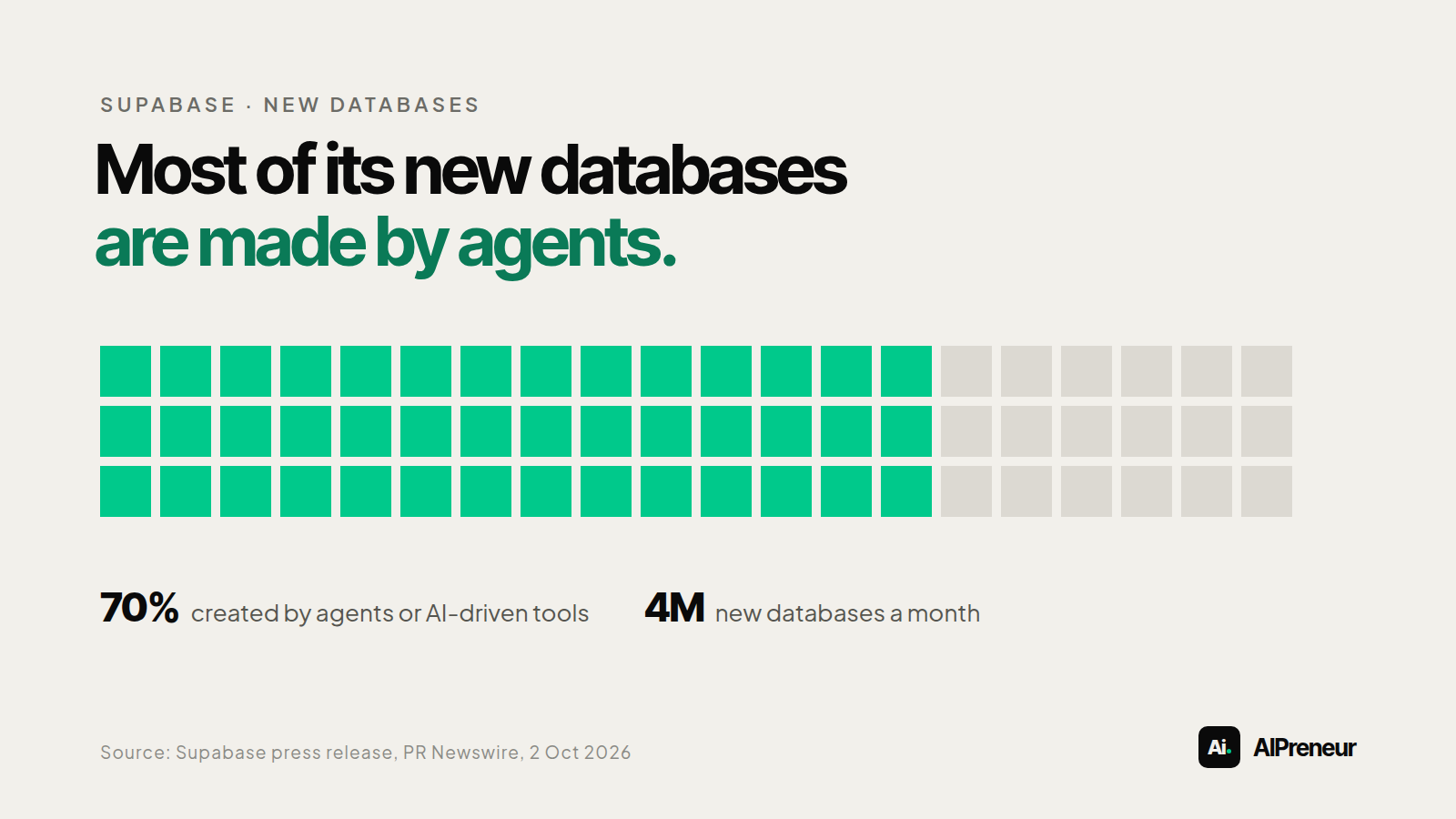
Supabase says AI tools now create 70% of new databases on its platform, changing how infrastructure wins demand.
A different user is arriving
Supabase says more than one million people use its platform and four million databases are created each month. The striking figure is who initiates that work: according to the company, agents and AI tools now create 70% of new databases.
That does not mean machines own the businesses or make every architecture decision. It means coding tools increasingly translate a person’s request into infrastructure actions. The interface that wins the developer may now need to win the developer’s agent first.
Capital follows the interface shift
On 2 October 2026, Supabase announced $150 million in new funding led by GIC, four months after a $500 million Series F. It also announced the acquisition of Turso, whose embedded and distributed database technology can run close to an application or agent.
Funding is not proof that the agent-created demand will be durable. The operating evidence is the volume of databases and whether those projects continue into useful products. Supabase’s reported share is nevertheless large enough to change how infrastructure companies think about onboarding, documentation and defaults.
Design for a software buyer
An agent-friendly service needs more than an API. It needs clear schemas, predictable errors, safe permissions, reversible actions and documentation that can be interpreted without guesswork. Provisioning should be fast, but recovery matters just as much when a tool makes the wrong change.
The opportunity extends beyond databases. Payments, hosting, analytics and business software will increasingly be selected or configured inside coding workflows. Products that make their value and constraints legible to both people and agents are better placed to capture that demand.
Infrastructure increasingly needs to be understandable, provisionable and repairable by software as well as people.
Sources and review
Developed from an approved AIpreneur post and reviewed against the cited sources on 4 October 2026.
- $150M funding and Turso acquisition — Supabase via PR Newswire
- Supabase is acquiring Turso — Supabase
The question behind every AIpreneur piece: why does this matter to someone building, creating or contributing to the AI economy?
← Back to News