$1 million through the checkout is not $1 million kept
LLM Gateway’s reported revenue shows why AI infrastructure businesses need to explain their take rate.
A milestone with an asterisk
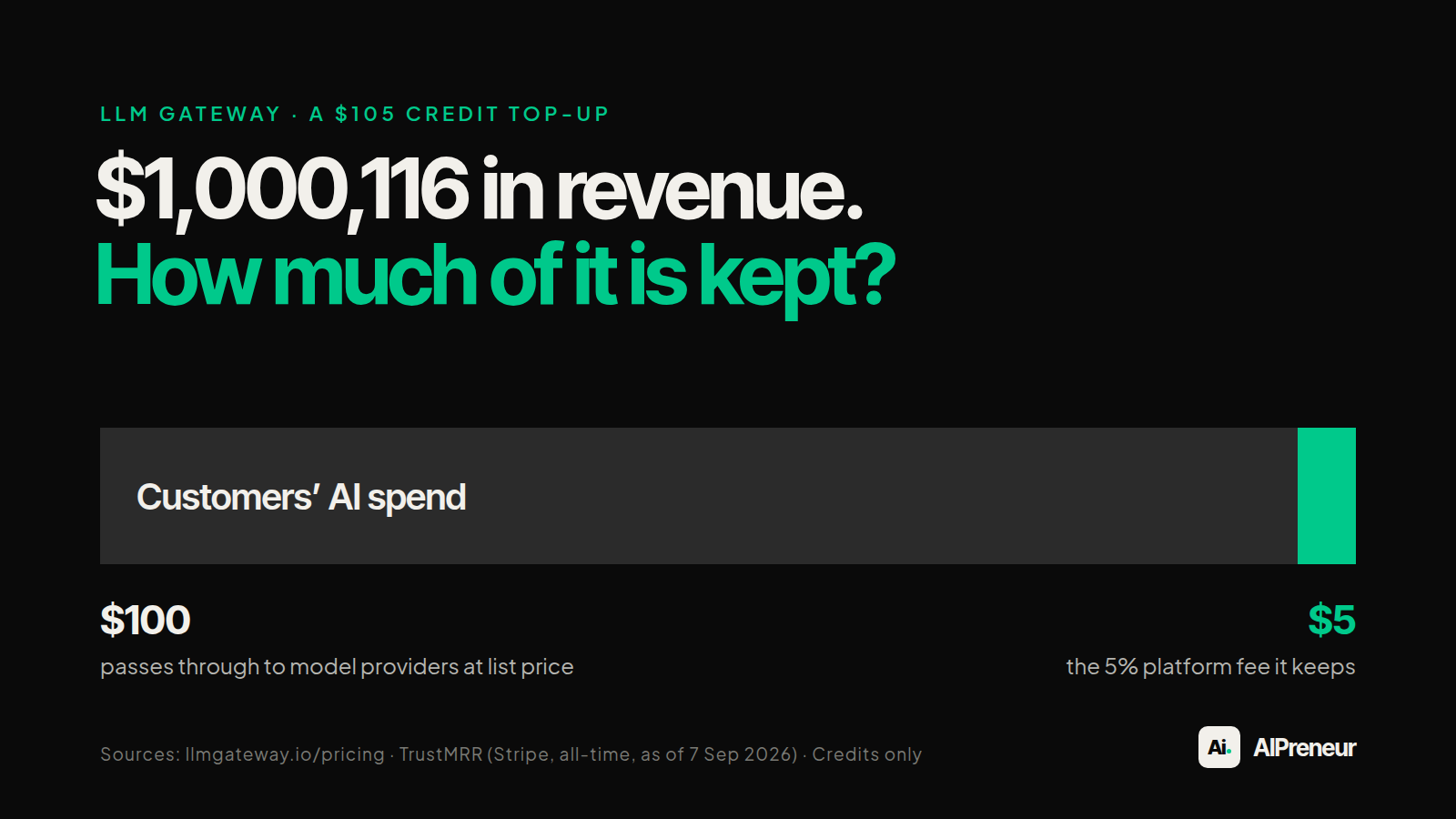
TrustMRR reports that LLM Gateway passed $1,000,116 in all-time Stripe revenue. The connected Stripe key expired on 7 September 2026, so the figure is a dated snapshot rather than a current live total. It is still a meaningful sign of demand for one interface across multiple model providers.
The headline needs interpretation. LLM Gateway says it sells provider credits at the provider’s listed token price and adds a flat 5% platform fee when customers buy credits. Much of the money moving through Stripe is therefore intended to pay model providers. It is payment volume passing through the business, not automatically revenue the company retains.
The economics live in the take rate
A gateway can create value by consolidating billing, routing requests and giving developers one integration. But a five-percent fee leaves a very different gross pool from a software subscription that retains most of every dollar. Costs for payment processing, infrastructure, support and failed transactions must be covered from the amount the platform keeps.
LLM Gateway also offers DevPass and Lounge subscriptions. Those products mean its retained revenue cannot be inferred by applying five percent to every Stripe dollar. The correct analysis separates credit volume, fee income and subscription income before drawing conclusions about margin.
Read the number behind the number
AI infrastructure often sits between a buyer and an upstream supplier. That structure can produce impressive payment totals while retaining a narrow share. Founders should publish or internally track gross payment volume, net revenue, gross margin and the cost of each layer separately.
The lesson is not that pass-through revenue is weak. It is that the business must earn its place on a thin slice. Routing quality, reliability, spend controls and developer experience determine whether customers accept the fee and whether the company can defend it.
In pass-through infrastructure, gross payment volume and retained platform revenue answer different questions.
Sources and review
Developed from an approved AIpreneur post and reviewed against the cited sources on 4 October 2026.
- LLM Gateway verified revenue profile — TrustMRR
- LLM Gateway pricing — LLM Gateway
The question behind every AIpreneur piece: why does this matter to someone building, creating or contributing to the AI economy?
← Back to News