Postiz shows how open source can become the sales funnel
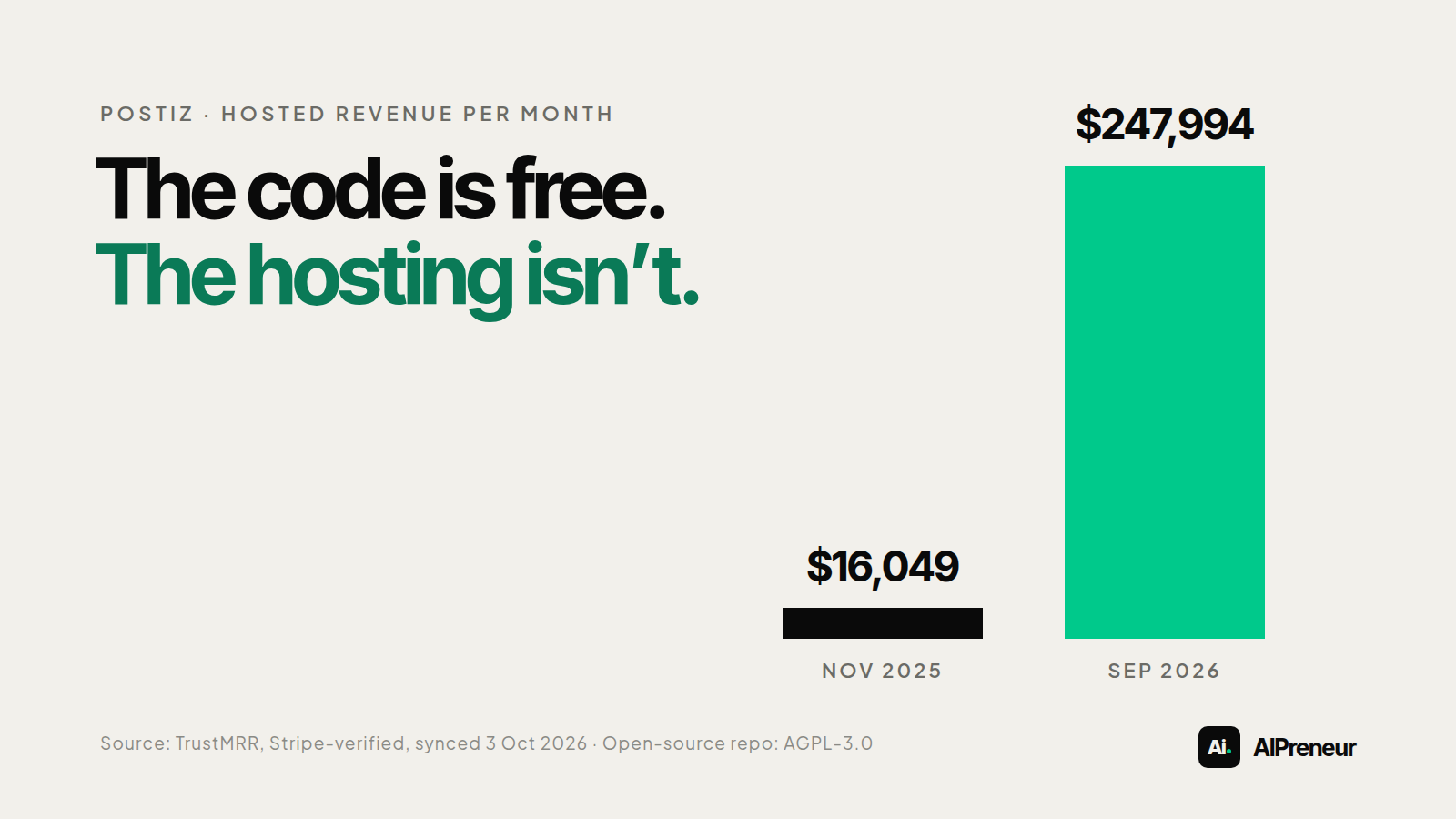
The scheduler’s public code is free. Its hosted service recorded $247,994 in September revenue.
Free code, paid relief
Postiz offers an open-source social-media scheduling product under the AGPL-3.0 licence. A capable team can inspect the code, run it on its own infrastructure and keep control of the deployment. The company also sells a hosted version, with plans beginning at $29 a month. The product is available either way; what changes is who carries the operational work.
That distinction is the business model. Hosting packages installation, updates, uptime and support into a recurring service. Customers are not being charged merely to reach code that is otherwise hidden. They are paying to avoid maintaining the system themselves.
The revenue signal
TrustMRR, which says its figures come from a connected Stripe account, records $16,049 in Postiz revenue for November 2025 and $247,994 for September 2026. Its public profile was last synchronised on 3 October 2026. The same profile showed 6,902 active subscriptions at that point; the approved post package recorded 6,927 when it was prepared, so the article uses the live source for the current count and preserves the dated graphic as supplied.
Revenue does not establish profit, retention or the cost of serving those accounts. It does show that a free, self-hostable product and a paid cloud service can coexist at meaningful scale. The repository gives prospective users a way to test the product and assess the team’s work. The hosted service turns a portion of that interest into recurring revenue.
What founders can take from it
The useful question is not whether to give software away. It is whether the free version creates trust and distribution while the paid offer removes a real burden. A repository with no route to adoption is not a funnel. A hosted plan that adds little convenience will struggle to justify its price.
Postiz makes the trade clear: use the public code and operate it yourself, or pay the company to run the service. That clarity is the product strategy. The code demonstrates capability; the managed experience is what customers buy.
Open source can distribute the product while hosting sells reliability, time and convenience.
Sources and review
Developed from an approved AIpreneur post and reviewed against the cited sources on 4 October 2026.
- Postiz verified revenue profile — TrustMRR
- Postiz pricing — Postiz
- Postiz open-source repository — GitHub
The question behind every AIpreneur piece: why does this matter to someone building, creating or contributing to the AI economy?
← Back to News